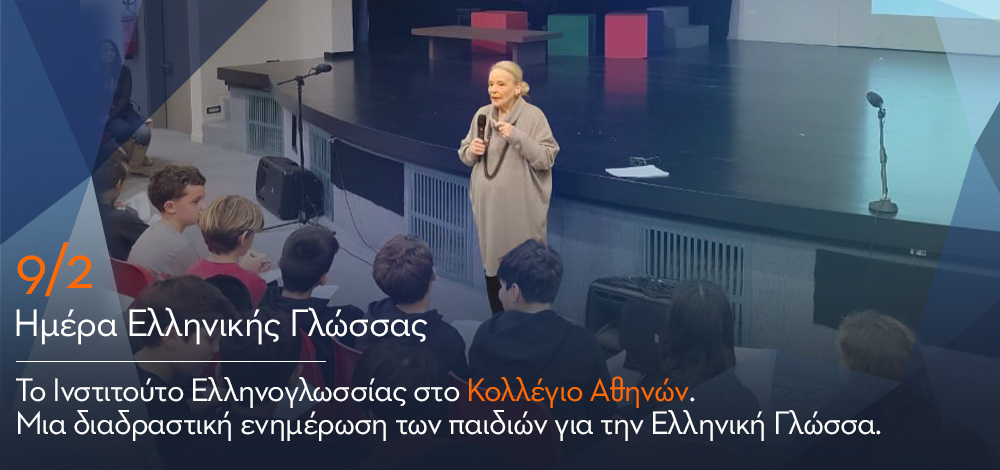
On 12 February 2026, Evangelia Georgantzi, President of the Greek Language Institute and a former teacher at this educational institution, was invited to speak to 180 pupils at the Latsio Primary School of Athens College about the Greek language, as part of the official celebration of Greek Language Day on 9 February.
The thirty-minute programme focused on four interactive strands and a fifth strand that transformed language into art.
First Strand: Explorers
The children explored, discovered, and underlined, in the first five lines of the ancient text of Homer’s Odyssey, words they recognised and still use today.
Aim: To help children experience and appreciate the historical continuity of the Greek language from antiquity to the present day.
Second Strand: Video with Garen, an Armenian Student Learning Greek in Istanbul
The children watched and listened to Garen, a 17-year-old Armenian from Istanbul, recount how, after a trip to Greece with his parents at the age of nine, he asked them to allow him to learn Greek out of love for the language, which had been unknown to him until he first heard it. It is a journey he continues to this day.
Aim: a. To help children realise that there is a whole world of young people across the globe who wish to learn Greek, b. To generate positive emotions among pupils towards their mother tongue.
Third Strand: Meeting the Letter-Heroes
The children watched an animated video accompanied by the song of the Letter-Heroes. The Letter-Heroes (people, animals, and magical creatures) form the society of “Letterland”, representing the 24 letters of the Greek alphabet as well as the digraphs.
The Letter-Heroes were created by Evangelia Georgantzi for children around the world who learn Greek as a second or foreign language.
Aim: a. To help children understand the relationship between letters, words, and concepts—such as theatre, philosophy, and mathematics—based mainly on the lyric of the song: “When you put them in order, an idea is born.” b. To spark children’s curiosity about the concept of the Letter-Heroes and the purpose of their creation.
Fourth Strand: The Ceremonial Closing in Three Movements
First movement: THOUGHT – Hand on the forehead Each child thinks of a word they love and would like to offer to children around the world who are learning Greek.
Second movement: SPEECH / WRITING – Hand on the mouth The word travels down to the mouth. The children do not say it aloud; instead, they write it.
Third movement: SENDING All 180 children send the word they chose by shouting it as loudly as they can to children around the world who are learning Greek.
Aim: To highlight the idea of spreading the Greek language, emphasise the cultural connection among children across the world through the Greek language, cultivate empathy for those who live far from Greece and learn the language, and strengthen a sense of collectivity and sharing.
Fifth Strand: Creating Works of Art
In the coming days, the children will create drawings in their classrooms on the theme of the Greek language, depicting how they imagine it. Their artworks will be published on the INEL website.
Aim: The transformation of language into art.